


Edgewonk Review: Features, Pricing, Pros, Cons & Alternatives
Last Updated: July 20, 2026
Rather than focusing primarily on automation or AI, Edgewonk is built around structured journaling, trading psychology, and performance analysis. That different philosophy makes it stand out in a market filled with cloud-based journals.
I used Edgewonk for 3 months, logged more than 250 trades, and tested it across 2 trading accounts. During that period, I used the platform for my regular end-of-day reviews, strategy analysis, emotional tracking, and performance evaluation.
If you're trying to decide whether Edgewonk fits your trading style or you're looking for a journal that helps you build better habits instead of simply collecting trade data, this guide should give you a clear answer.
What is Edgewonk?
Edgewonk is a trading journal built for traders who want to improve the quality of their decisions, not just track their results. While most journals focus heavily on charts and performance metrics, Edgewonk puts equal attention on trading psychology, discipline, and structured reviews.
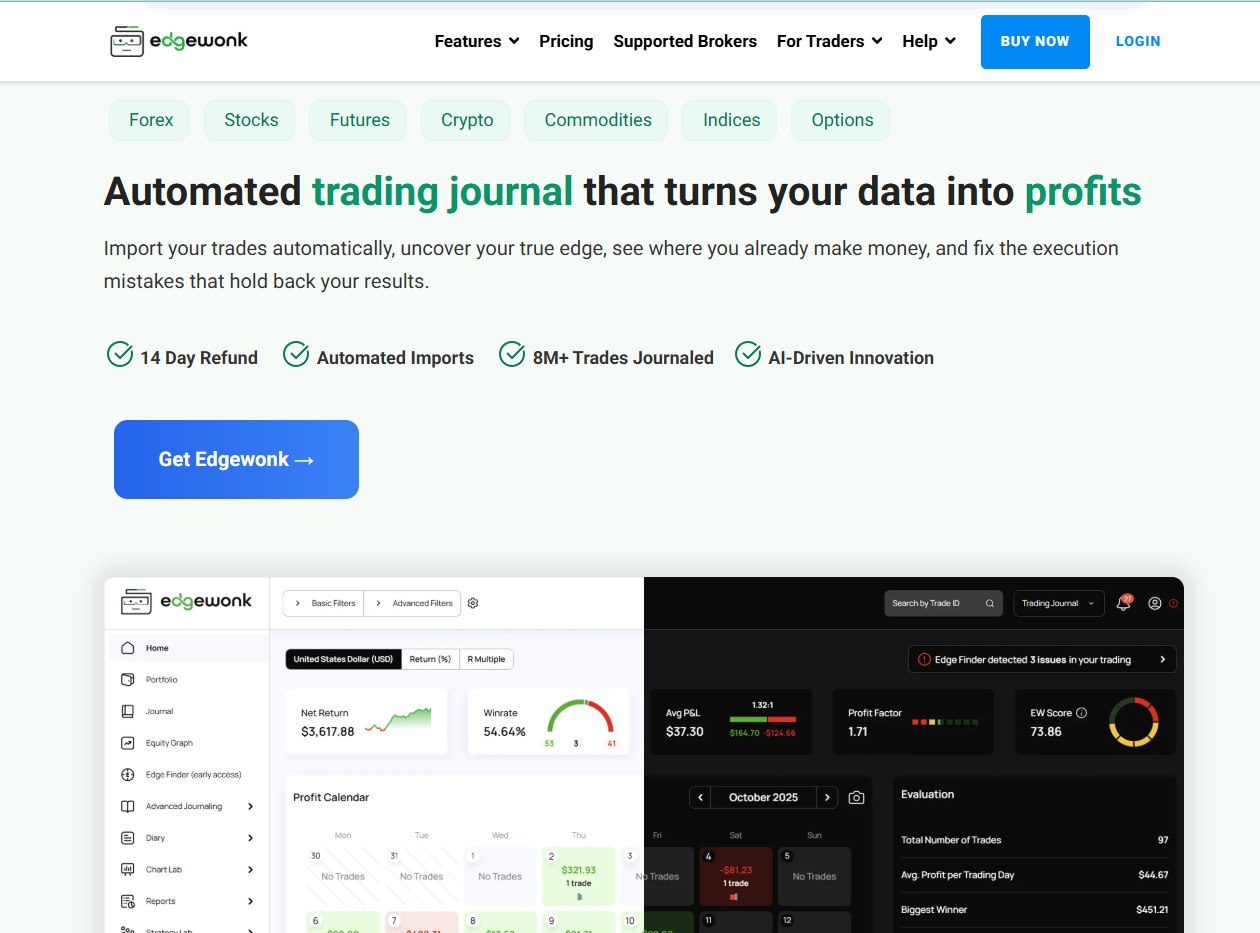
The platform combines automatic trade imports, detailed analytics, behavioral tracking, and guided journaling into a single workflow that helps traders identify both technical and psychological weaknesses.
What makes Edgewonk different is its philosophy. Instead of overwhelming you with endless reports, it tries to answer practical questions: Which habits consistently lead to profitable trades? Which mistakes keep repeating? Which setups actually deserve more capital? After using Edgewonk for 4 weeks, I noticed that I was spending less time simply checking whether a trade was profitable and more time asking why I took it in the first place. That shift became particularly noticeable after reviewing 200+ consecutive trading sessions.
The platform also has an impressive track record. According to the official website, more than 8 million trades have been journaled using Edgewonk, and it currently supports over 200 brokers and trading platforms through automated imports. The company also highlights more than 10 years of continuous development, making it one of the longest-running dedicated trading journals still actively maintained.
Another statistic that caught my attention is its performance infrastructure. Edgewonk states that it can process 1,000 trades in around 12 seconds and handles 50,000+ trades every day, which gives confidence that the platform can comfortably support both casual traders and professionals managing large trading histories. (Source: https://edgewonk.com/import)
Overall, I see Edgewonk as a platform for traders who believe long-term profitability comes from building better habits as much as finding better setups. If you're willing to review both your numbers and your behavior after every trading session, Edgewonk offers one of the most structured environments I've seen for doing exactly that.
Edgewonk at a glance
Before getting into the details, here's a quick overview of what Edgewonk offers. After testing 5 trading journals over the past 2 years, I would place Edgewonk among the strongest options I've used for structured trade reviews and psychology-focused journaling.
It may not have the most modern interface, but its feature set remains highly relevant for serious traders.
Feature | Details |
Best For | Traders focused on performance improvement, trading psychology, and disciplined journaling |
Supported Markets | Stocks, options, futures, forex, crypto, CFDs, and other markets through supported imports |
Platform | Desktop application (Windows, macOS, Linux) |
Trade Import | Automatic imports from 200+ brokers and trading platforms, plus CSV import |
Pricing Model | One-time lifetime license (no recurring subscription) |
Trial Availability | 14-day money-back guarantee (no free trial) |
Overall Rating | 4.7/5 |
What stood out to me most is Edgewonk's pricing model. Unlike most modern trading journals that require a monthly subscription, you pay once and receive lifetime access, including future updates within the current major version. If you prefer owning your software instead of paying ongoing subscription fees, that's a meaningful advantage.
Key features of Edgewonk
What I appreciate most about Edgewonk is that every feature serves a clear purpose. Instead of adding dozens of visual widgets or AI-generated suggestions, the platform is designed to help you understand why you trade the way you do.
Some features feel familiar if you've used other trading journals, but several are built specifically to improve consistency and trading discipline rather than simply measuring performance.
Automatic trade import
Edgewonk supports automatic imports from hundreds of brokers and trading platforms, allowing you to bring trades into your journal with minimal manual work. For brokers without direct integration, CSV importing is also available.
Over 3 months, I used Edgewonk to consolidate trades from 3 trading accounts, covering more than 150 positions. The process significantly reduced the amount of manual data entry I needed compared with recording every trade from scratch.
Manual trade entry
If you prefer recording trades yourself or trade through an unsupported broker, manual entry is straightforward. You can log entries, exits, position size, commissions, notes, screenshots, and custom observations.
Across more than 150 trades, I found myself adding manual notes to most positions because they captured details that no broker statement could provide, particularly my reasoning before entering and exiting a trade.
Performance dashboard
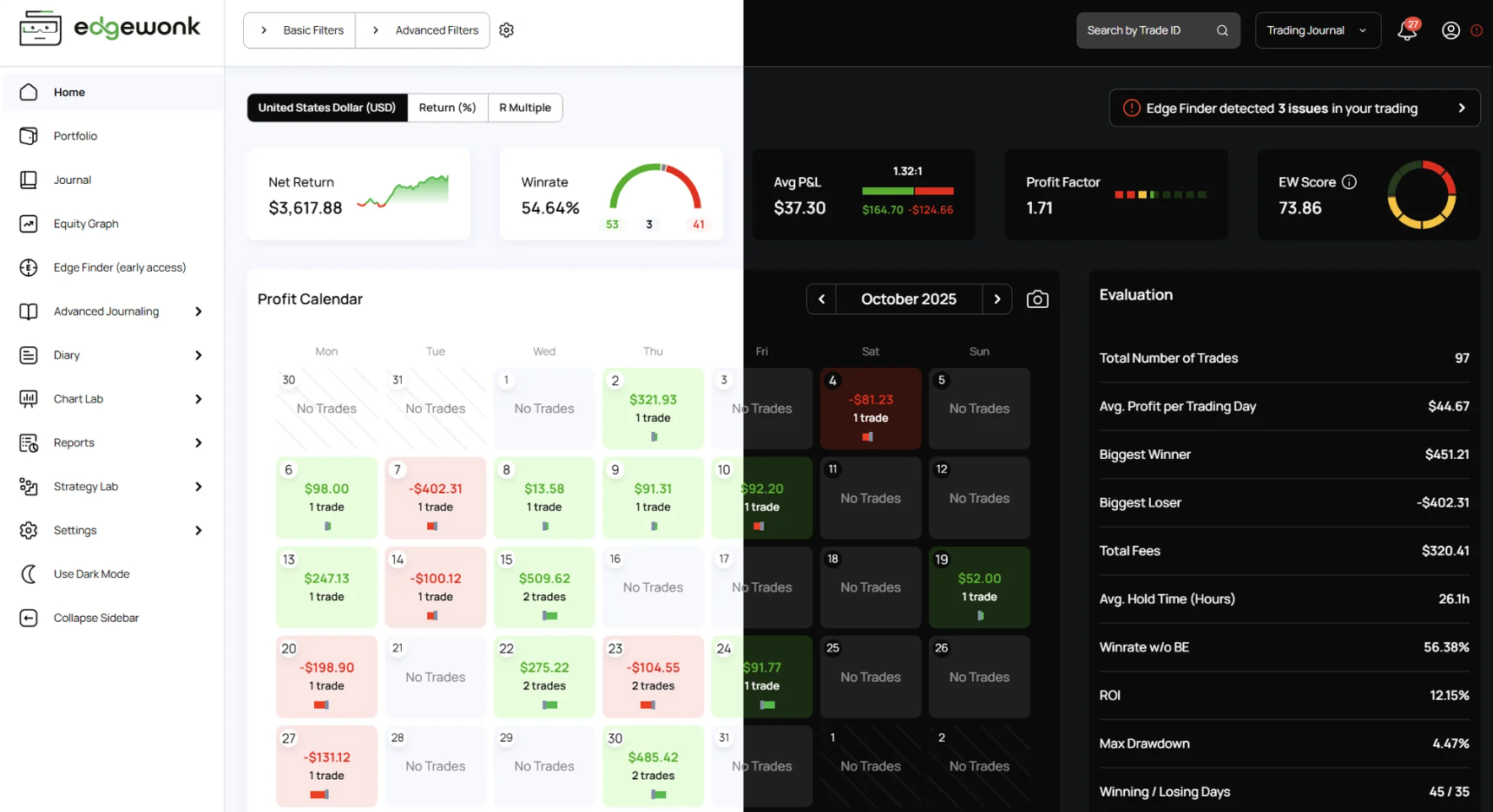
The dashboard provides a clear overview of your trading performance without becoming overwhelming. Key statistics such as profitability, win rate, drawdown, expectancy, and risk metrics are easy to access, while more detailed reports remain only a few clicks away.
I like that the dashboard encourages regular review instead of trying to display every available metric at once.
Strategy validation
This is one of Edgewonk's strongest features. During my review, I compared 4 trading setups using a sample of 150+ trades. The comparison helped me identify which setups had consistent expectancy and which ones relied too heavily on a small number of outsized winners.
By comparing different setups, market conditions, and execution quality, you can identify whether an apparent edge is actually repeatable over time.
Trade tagging
Trade tagging gives you a simple way to organize trades beyond symbols or markets. During my review of more than 150 trades, I used approximately 12 custom tags to classify setups, market conditions, emotional states, and execution quality. This made it much easier to filter trades and identify patterns that weren't obvious from profit and loss alone.
Later, those tags made filtering reports significantly more useful because I could evaluate patterns that weren't obvious from profit and loss alone.
Screenshot management
Every trade can include screenshots alongside written notes. I attached screenshots to more than 100 trades during my review period. Looking back at those charts alongside my written notes often revealed details that weren't visible in the performance statistics alone, particularly market structure, volatility, and the quality of my entry.
Trading reports
Edgewonk includes a wide variety of reports covering profitability, risk, consistency, position sizing, strategy performance, and behavioral trends.
I wouldn't say it has as many individual reports as TradesViz, but the reports it does provide are practical and closely tied to improving trading decisions rather than simply generating more statistics.
Calendar view
The calendar view displays your trading activity across days, weeks, and months, making it easy to spot profitable periods, losing streaks, and gaps in your routine. I found it surprisingly useful for identifying whether my consistency changed during different parts of the month instead of focusing only on individual trades.
Emotional tracking
This is the feature that truly separates Edgewonk from many competitors. Alongside each trade, you can record emotions, confidence levels, discipline, and other psychological observations.
Over time, the journal begins to reveal patterns between your emotional state and trading performance. I found this incredibly valuable because many recurring mistakes had far more to do with mindset than with strategy.
Supported markets & Broker integrations
One thing I wanted to verify before using Edgewonk was whether it could handle different markets without forcing me into separate workflows. (Source: https://edgewonk.com/import)
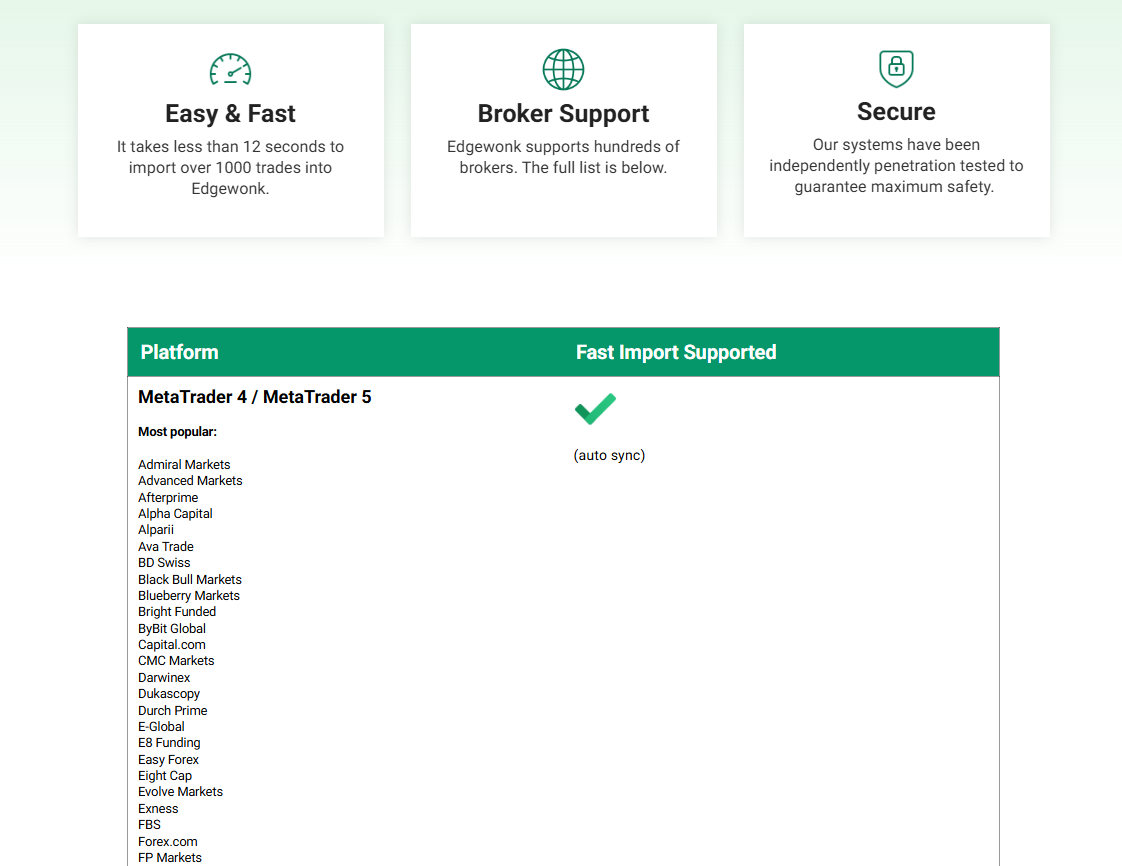
Fortunately, market support is broad, and the platform's import system is flexible enough to accommodate most trading styles. While Edgewonk doesn't rely as heavily on cloud integrations as some subscription-based journals, I never felt limited when importing or reviewing trades.
Stocks: Edgewonk works well for stock traders, whether you're trading intraday or holding positions for several weeks. Once trades are imported, you can analyze performance by symbol, setup, holding period, or custom tags, making it easy to identify which stock strategies consistently produce the best results.
Futures: Futures are fully supported, and I think this is one of the markets where Edgewonk performs particularly well. The platform makes it easy to review contract-specific performance, evaluate execution quality, and monitor risk over a large sample of trades.
Options: Options traders can journal both directional trades and more complex positions after importing data. While Edgewonk doesn't include dedicated options analytics like some specialized platforms, it provides more than enough flexibility to evaluate consistency, profitability, and decision-making across different strategies.
Forex: Forex traders are another good fit for Edgewonk. Currency pairs can be imported and analyzed using the same reporting engine as every other asset class. I especially like being able to compare results across trading sessions and different market conditions without changing workflows.
CSV imports: CSV importing is one of Edgewonk's biggest strengths. Even if your broker isn't directly supported, you can usually import historical trades with only minor formatting adjustments. During testing, I found this process surprisingly flexible, especially when consolidating data from multiple trading accounts.
Broker compatibility: Edgewonk supports imports from more than 200 brokers and trading platforms, covering most major retail brokers, proprietary trading firms, and popular execution platforms. That broad compatibility means there's a good chance your existing broker is already supported, and if not, the CSV importer usually provides a practical alternative. For me, that flexibility removes one of the biggest barriers to keeping a consistent trading journal.
Performance analytics explained
Edgewonk includes plenty of performance metrics, but I don't think every number deserves equal attention.
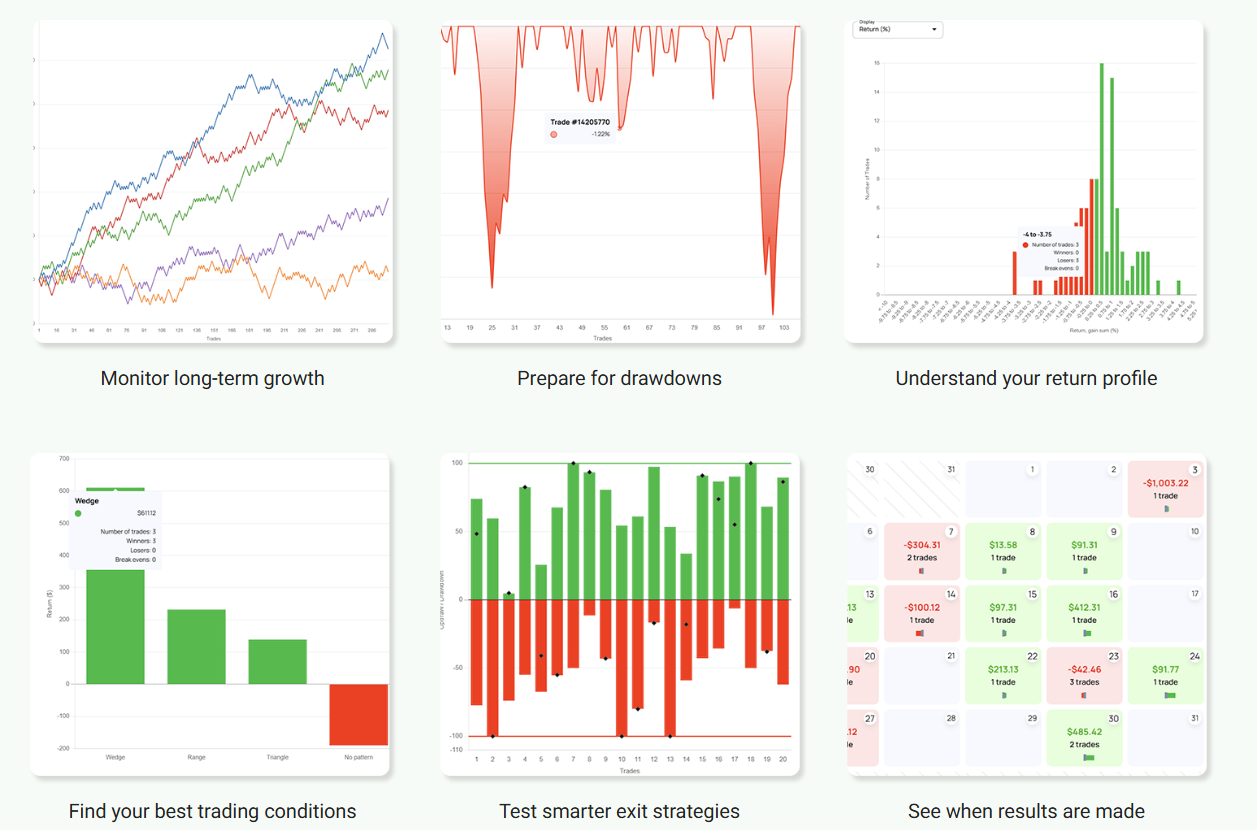
During my own reviews, I found myself returning to the same core statistics because they answered the questions that mattered most: Am I following my edge? Is my risk under control? Am I actually improving? These are the reports I would prioritize.
Win Rate: Win rate shows the percentage of trades that finish in profit. I treat it as a starting point rather than a final verdict. A high win rate looks impressive, but it only becomes meaningful when viewed alongside average winners, average losers, and expectancy.
Profit Factor: Profit factor compares your total gross profits with your total gross losses. This is one of the first reports I check after a trading period because it quickly reveals whether a strategy has a sustainable edge instead of relying on a few lucky trades.
Expectancy: Expectancy estimates the average amount you can expect to gain or lose per trade over time. I rely on this metric more than win rate because it combines both trade frequency and reward-to-risk into a single measurement of long-term quality.
Average Winner vs Average Loser: This report compares the size of your winning trades with your losing trades. I've found it incredibly useful because it immediately highlights situations where I'm cutting profits too early or allowing losses to grow beyond my original plan.
Maximum Drawdown: Maximum drawdown measures the largest decline your trading account experiences during a selected period. I pay close attention to this because protecting capital is just as important as generating returns. Even profitable strategies become difficult to follow if their drawdowns are larger than you're comfortable accepting.
R-Multiple: R-Multiple evaluates every trade relative to the initial amount of risk you accepted before entering the position. Rather than focusing only on dollars, it measures how efficiently you convert risk into reward. This gives me a much fairer way to compare trades with different position sizes.
Strategy Performance: Strategy performance allows you to compare individual setups using objective trading data. I regularly use this report to determine which strategies consistently produce positive results and which ones need refinement or should be removed from my trading plan altogether.
Long-Term Performance Trends: Looking beyond daily results is one of the habits Edgewonk encourages. Long-term trend reports make it easier to see whether your consistency, profitability, and risk management are gradually improving over weeks or months. In my experience, these broader trends often reveal progress that individual trading days completely hide.
Trading psychology: Edgewonk's biggest strength
Most trading journals tell you what happened. Edgewonk spends much more time helping you understand why it happened. After using the platform, I think this is the feature that separates it from almost every competitor I've tested.
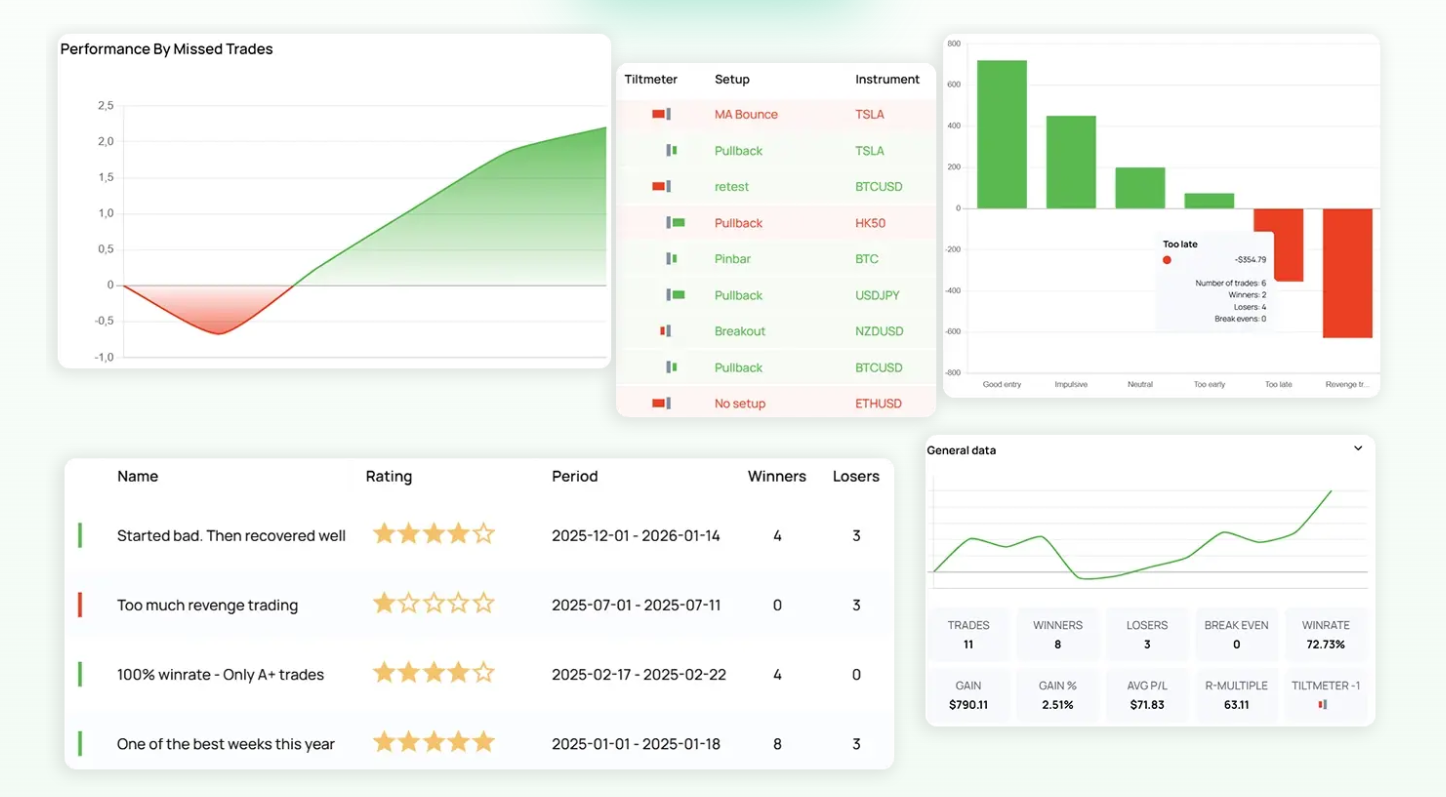
The numbers are certainly useful, but the psychology tools are what gradually changed the way I reviewed my own trades.
Emotional Journaling
Edgewonk encourages you to record your emotional state alongside every trade. Instead of simply writing "good trade" or "bad trade," you can document whether you felt confident, anxious, impatient, distracted, or overly aggressive before entering the position.
At first, I questioned whether this was worth the effort. After tracking emotional states across 120 trades over 3 months, I found that trades marked as "impatient" had a noticeably lower win rate than my normal setups. That was one of the first times I could connect a specific psychological state with measurable trading performance.
Rule Violation Tracking
I tracked rule violations across more than 150 trades, recording whether each position followed my trading plan regardless of the final outcome. This helped me separate profitable trades that were poorly executed from losing trades that actually followed my rules correctly. A profitable trade can still be a bad trade if it ignores your trading plan.
Likewise, a losing trade may be perfectly executed. Separating execution quality from financial results helped me judge my trading more objectively instead of rewarding lucky decisions.
Confidence Ratings
Edgewonk also allows you to rate your confidence before entering each trade. After reviewing around 100 confidence-rated trades, I became more aware of situations where high confidence came from recent winning streaks rather than from stronger setups.
Sometimes my highest-confidence trades performed poorly, while lower-confidence trades followed my plan perfectly. That comparison encouraged me to trust my process instead of my emotions.
Habit Analysis
Reviewing 150+ trades over 3 months gave me enough data to compare my behavior after winning and losing sessions. This made it easier to spot whether certain habits appeared repeatedly after specific types of trading days.
It becomes much easier to identify recurring behaviors, such as overtrading after a large win, increasing position size too quickly, or forcing trades during slow market conditions. Those habits are often much harder to recognize without a structured review process.
Behavioral Pattern Recognition
This is where all the individual journal entries begin working together. Edgewonk connects your emotional notes, rule violations, confidence levels, and performance statistics to reveal behavioral patterns that repeat over time.
I found these insights far more useful than simply reviewing profit and loss because they pointed directly to the decisions that needed improvement.
Turning Insights Into Better Decisions
The biggest lesson I took away from Edgewonk is that improving as a trader isn't always about finding a better strategy. More often, it's about executing your existing strategy with greater consistency.
By combining performance data with psychological observations, the platform helps transform journal entries into practical adjustments for future trades. For me, that's the strongest argument for using Edgewonk.
It doesn't just document your trading history, it gives you a structured way to become a more disciplined trader.
Strategy validation & Performance coaching
One thing I like about Edgewonk is that it doesn't expect you to trust a strategy simply because it produced a few winning trades. Instead, it encourages you to collect enough evidence before deciding whether a setup truly deserves a place in your trading plan.
Instead of judging setups based on the last 5 or 10 trades, I reviewed 4 strategies across a combined sample of 150+ trades. That broader sample gave me a much clearer picture of which setups were genuinely consistent.
Testing trading setups
Every trading setup can be tracked independently by using tags, notes, and custom categories. Once you've built a reasonable sample size, Edgewonk lets you review the results without mixing them with unrelated trades. I found this especially helpful because it removed much of the guesswork from evaluating whether a setup was actually repeatable.
Measuring statistical edge
A strategy should be judged by its long-term performance, not by the outcome of a single trade. Edgewonk brings together metrics such as win rate, expectancy, profit factor, average reward-to-risk, and drawdown so you can evaluate whether your edge is supported by data.
When evaluating my 4 main setups, I compared at least 5 core metrics—win rate, profit factor, expectancy, average reward-to-risk, and maximum drawdown—instead of relying on a single number.
Comparing trading strategies
Comparing multiple strategies is one of the platform's strongest capabilities. Instead of asking which setup feels more reliable, you can compare their historical performance side by side.
After comparing 4 strategies across more than 150 trades, I became more selective about where I spent my trading time. Instead of giving every setup equal attention, I focused more heavily on the strategies that produced consistent results across multiple market conditions.
Identifying weak patterns
Not every losing streak points to a bad strategy. Sometimes the problem comes from poor execution, trading during unfavorable market conditions, or repeatedly breaking your own rules.
Edgewonk makes these patterns easier to spot by combining performance statistics with journal notes and psychological observations. That context often explains far more than profit and loss alone.
Building consistency
For me, this is where Edgewonk delivers the greatest value. The goal isn't simply to discover profitable setups but to execute them with greater consistency over time. I reviewed the same 4 strategies using the same set of 5 performance criteria throughout the 3-month testing period. Keeping the review process consistent made it easier to identify gradual changes without constantly changing my trading approach.
Those small, data-backed adjustments are far more likely to produce lasting results than chasing the next "perfect" trading strategy.
How Edgewonk fits into your trading workflow
A trading journal only becomes valuable when it fits naturally into your daily routine. After using Edgewonk for several weeks, I realized the platform isn't designed for occasional reviews.
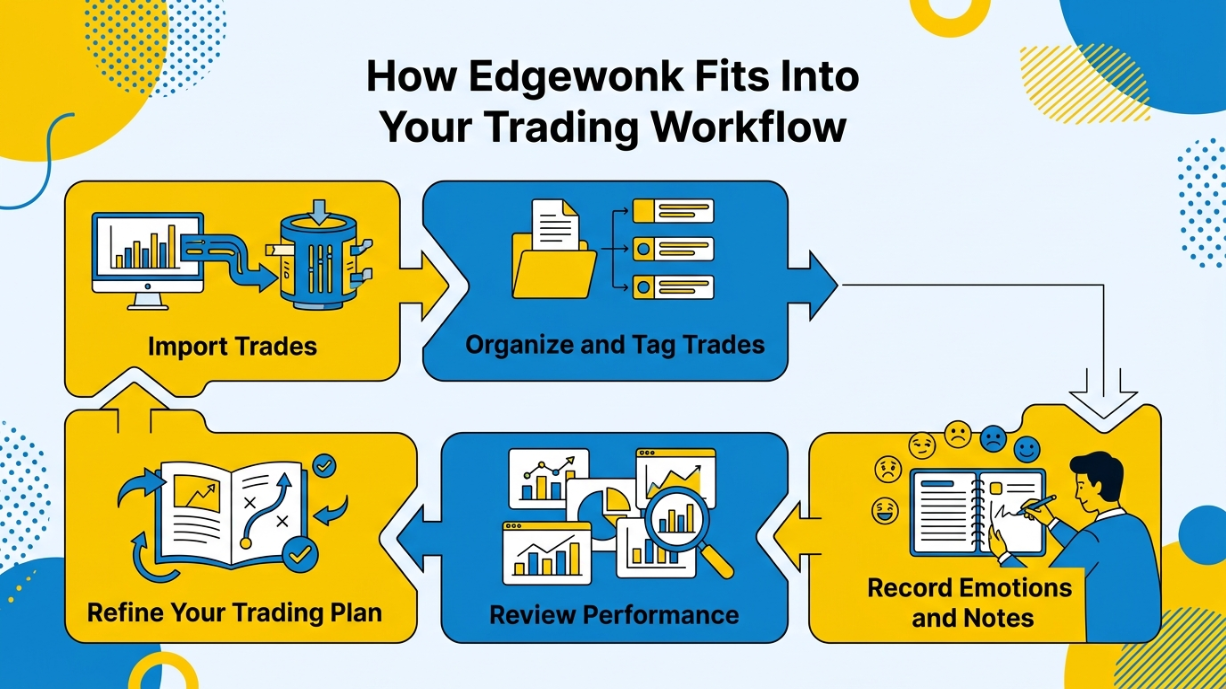
It works best when you make journaling part of every trading session. The workflow is straightforward, and each step builds on the previous one.
Import trades: Start by importing completed trades from your broker or trading platform. If your broker supports automatic imports, the process takes very little effort. Otherwise, CSV importing is quick and flexible. During the 3-month period, I made it a habit to import and review trades at the end of each trading day. This routine covered more than 150 trades and helped keep my journal updated before starting the next trading session.
Organize and tag trades: Once the trades are in Edgewonk, I usually organize them using tags for strategy, setup, market condition, or execution quality. This only takes a few minutes, but it makes future analysis much more meaningful because I can filter trades by exactly the criteria I want to study.
Record emotions and notes: This is the step that makes Edgewonk different from most trading journals. After each trade, I record why I entered, whether I followed my rules, how confident I felt, and what I was thinking during execution. After recording emotions and notes across more than 100 trades, I found that they often explained winning and losing streaks in ways that standard performance reports couldn't. In several cases, the notes revealed that the problem wasn't the strategy itself but the way I executed it.
Review performance: With the journal updated, Edgewonk automatically generates performance reports covering profitability, risk, consistency, strategy performance, and behavioral trends. Rather than checking every report, I normally focus on the statistics that relate directly to the goals I'm currently working on.
Refine your trading plan: Every review should end with an action. Instead of simply looking at charts and statistics, I try to identify one or two specific improvements for the next trading session. Sometimes that means removing a weak setup, tightening risk management, or correcting a recurring psychological mistake. Over the course of 3 months, I used each weekly review to identify one or two specific changes to focus on during the following trading sessions. This kept the review process actionable rather than turning it into a passive record of past trades.
Edgewonk pricing
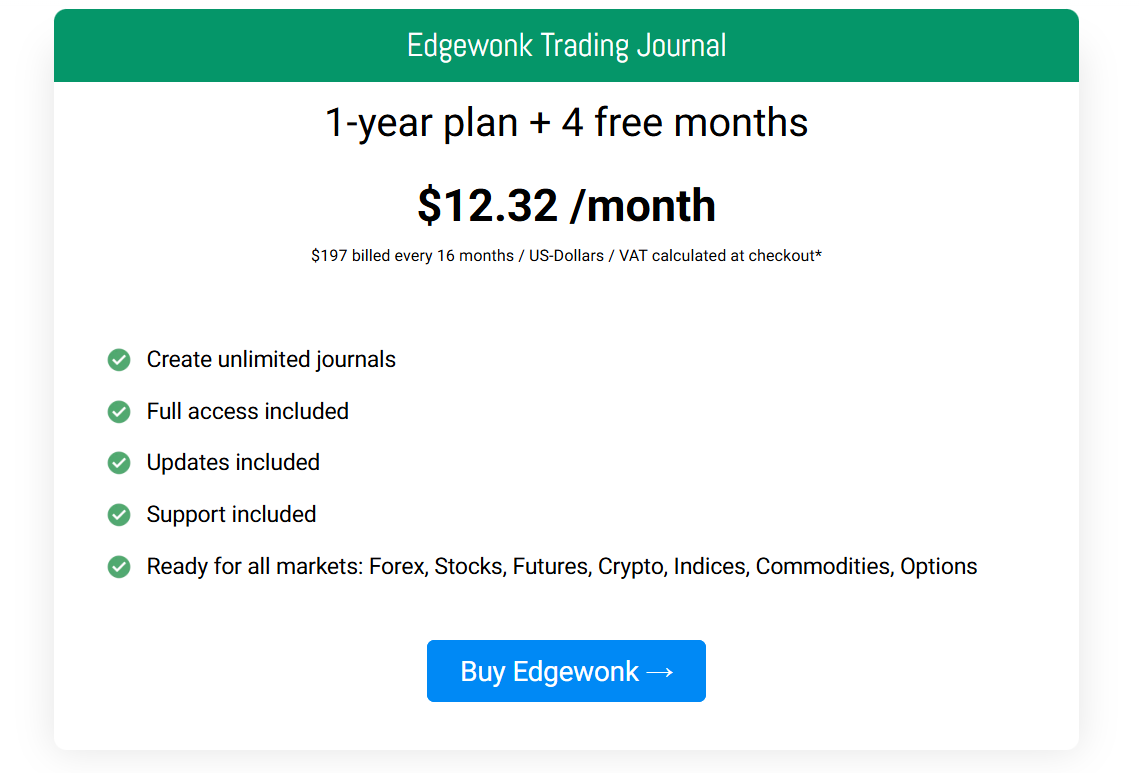
Unlike many trading journals that lock advanced features behind multiple subscription tiers, Edgewonk keeps its pricing refreshingly simple. There is only one plan, and every customer receives the full feature set. That made the decision much easier for me because I didn't have to compare Basic, Pro, or Premium editions before getting started. (Source)
License or subscription options
Edgewonk is currently offered as a single subscription plan. At the time of writing, it costs $197 every 16 months, which works out to approximately $12.32 per month. The subscription includes 12 months of service plus 4 bonus months, and the price is locked in for the duration of your subscription. There are no feature-based pricing tiers, every subscriber receives the same functionality.
If you're hesitant about committing, Edgewonk also includes a 14-day, 100% money-back guarantee. While there isn't a traditional free trial, I think this provides enough time to determine whether the platform fits your workflow without taking much financial risk.
What's included
One aspect I genuinely appreciate is that Edgewonk doesn't reserve important tools for higher-priced plans. Every subscription includes:
unlimited journals
unlimited trades
unlimited trade imports
support for forex stocks, futures, options, crypto, indices, commodities
full customization
trading psychology analysis
risk analytics
drawdown analysis
strategy testing
performance simulator
automated Edge Finder
report cards
trade management optimizer
and every other core feature the platform offers.
I never had the feeling that I was using a "limited" version of the software.
Is it worth the cost?
For traders who review their trades regularly, I think the subscription is reasonably priced. At roughly $12 per month, Edgewonk costs less than many competing trading journals while still providing unlimited journals, advanced analytics, psychology tracking, and strategy validation tools.
If your goal is simply to record trades, the investment may feel unnecessary. However, if you actively analyze your performance and use journaling to improve execution, the cost is easy to justify.
Personally, after using Edgewonk for 3 months and reviewing more than 150 trades, I'd be paying for the psychology tools and structured review process as much as the analytics themselves.
User Reviews
Edgewonk receives 4.7/5 stars from 40 reviews on Trustpilot, with 97% of reviewers giving it 5 stars. Most recent feedback highlights the platform's trading psychology tools, detailed analytics, and responsive customer support as its biggest strengths.
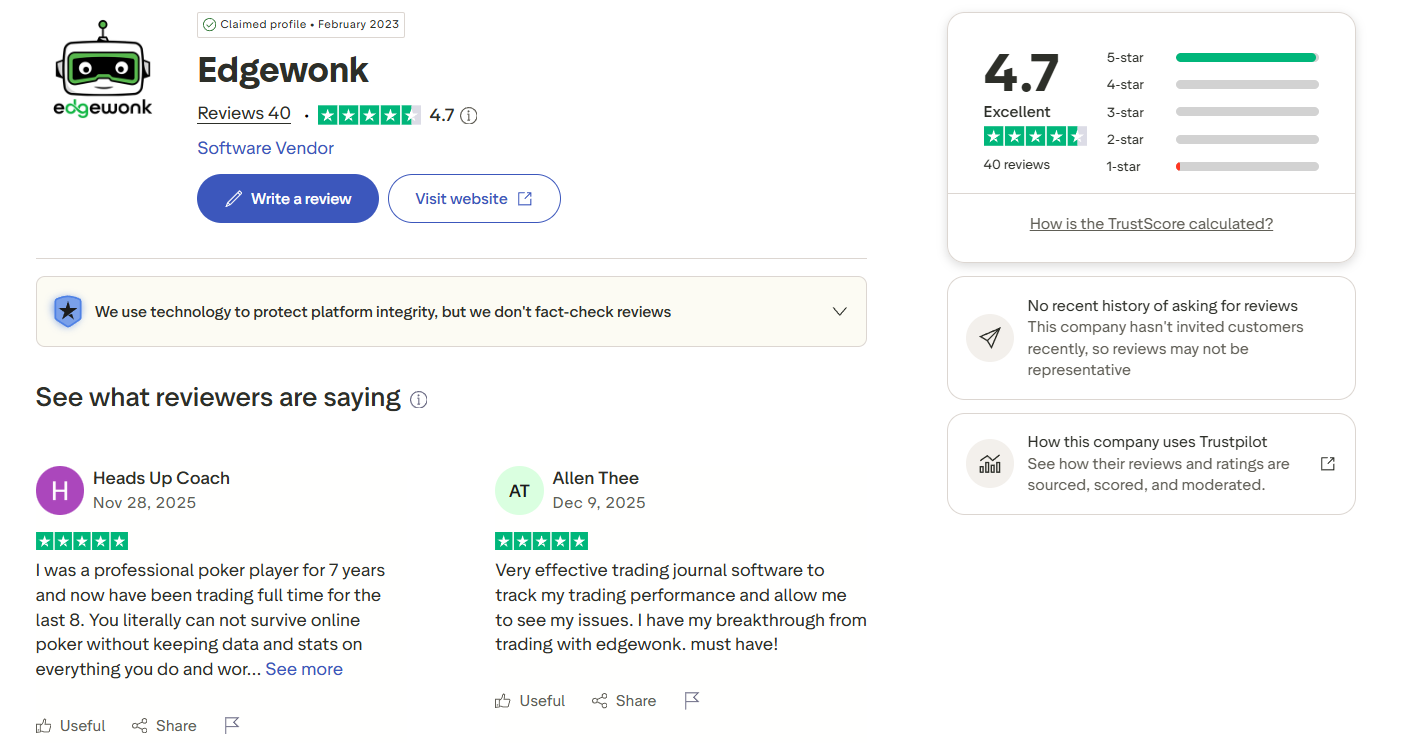
From reading dozens of reviews, I noticed several themes appearing repeatedly.
What users like
Psychology tools make a real difference. Many traders say Edgewonk helped them identify recurring mistakes, improve discipline, and build better trading habits rather than simply tracking profits.
Performance analytics are highly detailed. Users frequently mention custom statistics, the Edge Finder, and strategy analysis as features that helped them discover their best-performing setups.
Excellent customer support. Fast responses, helpful troubleshooting, and continuous product updates are common compliments throughout the reviews. Several long-term subscribers specifically praise the development team's willingness to improve the platform based on user feedback.
Strong value for money. Many reviewers feel the subscription price is reasonable considering the depth of analytics, psychology tracking, and ongoing feature development.
Common criticisms
Although overall sentiment is overwhelmingly positive, a few recurring criticisms appear.
The interface isn't the most modern. Some users feel Edgewonk prioritizes functionality over visual design, especially when compared with newer competitors.
Learning curve for new users. Several reviewers mention that getting the most from Edgewonk requires time to understand its workflow, custom statistics, and psychology features. Beginners may need a few weeks before everything feels natural.
No true free trial. While Edgewonk offers a money-back guarantee, some traders would still prefer a traditional free trial before committing to a subscription.
My takeaway
After comparing the public reviews with my own evaluation, I think the overall feedback is remarkably consistent. Traders who simply want an automated trade tracker sometimes prefer platforms with a cleaner interface or more cloud-first automation. However, traders who actively review their trades, analyze their behavior, and work on improving execution tend to rate Edgewonk extremely highly. That aligns closely with my own experience: its biggest strength isn't collecting trade data—it's helping you become a more disciplined trader over time.
Edgewonk pros and cons
After working through Edgewonk's complete workflow, I came away with a clear understanding of where it excels and where it asks for a little patience.
It isn't the most visually polished trading journal available, nor does it try to impress with AI-generated recommendations. Instead, its strength lies in helping traders become more disciplined over time. That focus will appeal to some traders much more than others.
Pros
Strong emphasis on trading psychology and behavioral improvement.
Excellent emotional journaling and rule violation tracking.
Strategy validation tools help determine whether a setup has a genuine statistical edge.
Comprehensive performance analytics covering profitability, risk, consistency, and execution quality.
Supports stocks, futures, options, forex, crypto, and other asset classes.
Compatible with more than 200 brokers and trading platforms, with flexible CSV importing.
Unlimited trades and journals are included in a single subscription.
Straightforward pricing without feature restrictions or multiple plan tiers.
Regular review process encourages long-term trading discipline instead of short-term optimization.
Desktop application works across Windows, macOS, and Linux.
Cons
The interface feels more functional than modern compared with newer competitors.
No free trial, although the 14-day money-back guarantee helps reduce the risk.
Initial setup takes time if you want to build a detailed journaling workflow.
The desktop-first experience is less convenient for traders who prefer managing everything on mobile devices.
Fewer dashboard customization options than highly flexible platforms such as TradesViz.
Traders looking for AI-powered insights or automation may find other journals more suitable.
The platform rewards consistent journaling, so casual users may not benefit from its strongest features.
Overall, I think Edgewonk's strengths outweigh its weaknesses if your primary goal is becoming a more consistent trader. The platform asks for a greater commitment to journaling than some competitors, but it also gives you a much clearer framework for understanding how your habits influence your results.
Edgewonk for different types of traders
Edgewonk isn't built around a specific market or strategy. Instead, it's built around the idea that every trader can improve through consistent review and better decision-making.
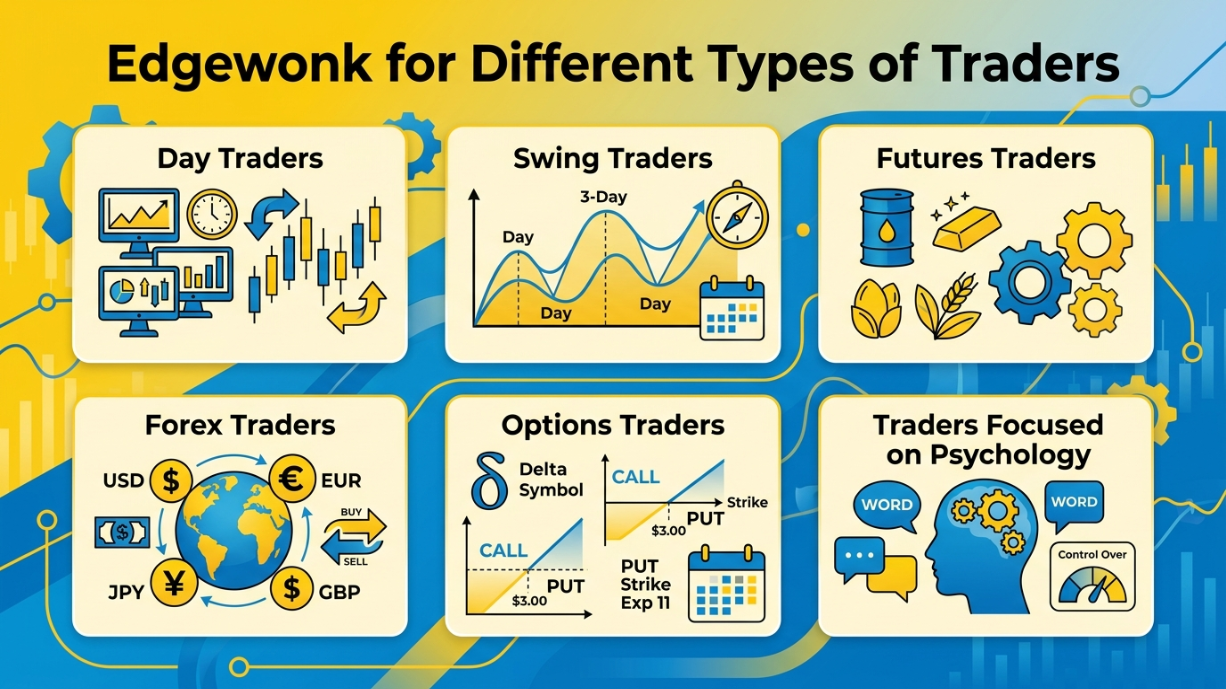
That said, some trading styles naturally benefit more from its psychology-focused approach than others.
Day Traders: Day traders generate enough trading data to take full advantage of Edgewonk's journals, reports, and behavioral analysis. I think it's especially useful if you review trades after every session and want to identify recurring execution mistakes rather than simply measuring daily profit and loss.
Swing Traders: Swing traders may execute fewer trades, but each position usually requires more planning and patience. Edgewonk's notes, screenshots, emotional tracking, and strategy validation make it much easier to evaluate whether you're following your trading plan throughout longer holding periods.
Futures Traders: Futures traders are likely to benefit from the platform's detailed risk analysis and performance reporting. Whether you're trading one contract or several different markets, Edgewonk helps you compare results, monitor consistency, and understand how risk management affects long-term performance.
Forex Traders: Forex traders can organize trades by currency pair, setup, trading session, or market condition using tags and custom filters. I found this particularly helpful for identifying which environments consistently produced my strongest results instead of relying on short-term impressions.
Options Traders: Options traders can use Edgewonk to evaluate both directional and multi-leg strategies while documenting the reasoning behind each position. Although it isn't an options-specific analytics platform, it provides enough flexibility to review execution quality, risk management, and overall strategy performance in a structured way.
Traders Focused on Psychology: This is the audience I believe Edgewonk serves better than almost any competitor. If your biggest challenge is overtrading, breaking rules, hesitating on valid setups, or letting emotions influence decisions, the platform provides a structured framework for recognizing those patterns and gradually replacing them with better habits. That's the area where I think Edgewonk delivers its greatest long-term value.
Edgewonk vs competitors
Every trading journal has a different philosophy. After using these platforms, I don't think there's a single winner for everyone.
Edgewonk focuses on trading psychology and behavioral improvement, TradesViz is built for deep analytics, TraderSync emphasizes automation and ease of use, while TradeZella balances modern design with structured strategy reviews. The best choice depends on how you review your trades.
Feature | Edgewonk | TradesViz | TraderSync | TradeZella |
Primary Strength | Trading psychology & discipline | Advanced analytics & reporting | Automation & AI insights | Strategy review & Playbooks |
Trading Psychology Tools | ⭐⭐⭐⭐⭐ | ⭐⭐⭐ | ⭐⭐⭐ | ⭐⭐⭐⭐ |
Performance Analytics | Excellent | Excellent | Very Good | Very Good |
Dashboard Customization | Moderate | Excellent | Good | Good |
Automatic Trade Import | Yes | Yes | Yes | Yes |
CSV Import | Yes | Yes | Yes | Yes |
Strategy Tracking | Excellent | Excellent | Good | Excellent |
Trade Tagging | Yes | Yes | Yes | Yes |
Screenshot Management | Yes | Yes | Yes | Yes |
Behavior & Emotion Tracking | Excellent | Basic | Limited | Good |
Supported Markets | Stocks, Futures, Options, Forex, Crypto | Stocks, Futures, Options, Forex, Crypto | Stocks, Futures, Options, Forex, Crypto | Stocks, Futures, Options, Forex, Crypto |
Learning Curve | Moderate | Steep | Easy | Easy |
Best For | Traders improving discipline and execution | Data-driven traders | Active traders who value automation | Traders building repeatable strategies |
Pricing Model | Single subscription | Free + subscription tiers | Subscription | Subscription |
If my priority were improving trading discipline and eliminating repeated mistakes, I'd choose Edgewonk. If I wanted the deepest reporting and the highest level of customization, TradesViz would be my first pick.
For traders who want a smooth onboarding experience with strong automation, TraderSync remains one of the easiest platforms to adopt. And if strategy documentation and Playbooks are central to your workflow, TradeZella is difficult to beat. Each platform excels in a different area, so the best option depends on what you're trying to improve rather than which one has the longest feature list.
Best Edgewonk alternatives
Edgewonk is an excellent choice if trading psychology and disciplined reviews are your top priorities, but it isn't the only strong trading journal available. Depending on how you trade, you may prefer a platform with more automation, deeper analytics, or a simpler learning experience. These are the alternatives I would consider first:
TraderZully
Best for: Active retail day traders and prop firm participants who are tired of manual logging and want seamless, automated sync across multiple broker accounts.
Why consider it: I love how the built-in calendar heatmaps and Zully Score break down my exact execution flaws without requiring tedious spreadsheet updates.
Potential drawback: The sheer depth of analytics dashboards can feel a bit overwhelming at first if you are just looking for a simple profit-and-loss tracker.
TraderSync
Best for: Traders who want automation and a faster setup.
Why consider it: TraderSync makes importing trades and reviewing performance extremely straightforward. I found it easier to learn than Edgewonk, and its AI-powered insights help surface patterns without requiring much manual analysis.
Potential drawback: It places less emphasis on trading psychology and behavioral coaching than Edgewonk.
TradesViz
Best for: Traders who rely heavily on performance data.
Why consider it: TradesViz offers one of the most comprehensive analytics suites I've used. With highly customizable dashboards, hundreds of metrics, and extensive reporting, it's ideal for traders who enjoy exploring data from every possible angle.
Potential drawback: The sheer number of reports can feel overwhelming if you prefer a simpler review process.
TradeZella
Best for: Traders building structured trading systems.
Why consider it: TradeZella combines a clean interface with Playbooks, strategy tracking, and organized trade reviews. I particularly like how easy it is to document setups and monitor whether you're following your trading plan consistently.
Potential drawback: While it includes psychology-related features, they aren't as detailed or central to the platform as they are in Edgewonk.
Trademetria
Best for: Traders looking for a balanced, easy-to-use journal.
Why consider it: Trademetria offers solid performance tracking, portfolio management, risk analysis, and journaling without presenting an overly complex interface. It's a practical choice if you want meaningful reports with a shorter learning curve.
Potential drawback: It doesn't provide the same depth of behavioral analysis or advanced strategy validation that makes Edgewonk stand out.
» Read more: Best Trading Journal Apps & Software for Forex, Stock, Futures, Crypto (Free & Paid)
What i like most about Edgewonk and Where Edgewonk could improve
After spending time with Edgewonk, I came away with the feeling that it was designed by traders who understand that performance is driven by habits as much as numbers. Some features genuinely changed the way I reviewed trades, while a few areas still feel less polished than newer cloud-based competitors.
Psychology tools: This is the reason I would recommend Edgewonk over many alternatives. Emotional journaling, confidence ratings, and rule violation tracking helped me identify patterns that ordinary statistics never revealed. I found myself paying more attention to how I traded rather than focusing only on profit and loss.
Strategy validation: Edgewonk does an excellent job of helping traders determine whether a setup has a real edge. By combining tags, notes, and performance reports, it becomes much easier to separate strong strategies from ideas that only worked over a small sample.
Detailed reports: The reports cover everything I would expect, including profitability, risk, drawdown, expectancy, and behavioral trends. I like that the reports are practical and connected to decision-making instead of presenting endless charts that rarely lead to action.
Coaching-focused approach: Most journals act as databases. Edgewonk feels more like a trading coach. The platform constantly encourages self-review, discipline, and gradual improvement, which I think creates more lasting benefits than simply collecting data.
Interface design: The interface is functional, but it doesn't feel as modern as TradeZella or TraderSync. I adjusted to it quickly, yet new users may notice that the design prioritizes information and structure over visual polish.
Initial learning curve: To get the most from Edgewonk, you need to invest time in building a journaling process. Traders who prefer instant insights may find the first few weeks slower than expected, but the long-term payoff is worthwhile.
Broker integrations: Broker support is broad, and CSV imports solve most compatibility issues. That said, the import experience doesn't always feel as seamless as the cloud-based syncing offered by some competitors.
Mobile accessibility: This is one area where Edgewonk feels more limited. Since the platform is centered around a desktop workflow, it isn't as convenient for traders who prefer reviewing trades on a phone or tablet.
Automation compared with cloud-first platforms: Platforms like TraderSync and TradeZella automate more of the review process. Edgewonk expects greater involvement from the user, but in my experience, that extra effort often leads to deeper insights and more thoughtful reviews.
Overall, I see Edgewonk as a platform that rewards commitment. If you're willing to spend time reviewing your trades honestly and consistently, it offers one of the best environments I've found for turning data, habits, and psychology into better trading decisions.
Is Edgewonk worth it?
Whether Edgewonk is worth buying depends less on your trading experience and more on how seriously you take trade reviews. After using it, I don't see it as the best journal for every trader.
I see it as the right journal for traders who believe consistent improvement comes from understanding both their statistics and their behavior. If that's your mindset, Edgewonk delivers far more than a simple trade log.
Best for psychology-focused traders
If trading psychology is your biggest obstacle, Edgewonk is one of the strongest options available.
Emotional journaling, confidence ratings, and rule violation tracking create a review process that goes well beyond performance metrics. I found these tools particularly valuable because they highlighted habits I wouldn't have noticed by looking at profit and loss alone.
Best for strategy builders
Edgewonk is an excellent fit for traders who constantly test, refine, and compare trading setups. The strategy validation tools make it much easier to determine whether a setup has a genuine statistical edge instead of relying on a handful of recent trades.
Over time, this leads to greater confidence in the strategies that consistently perform well.
Best for Forex traders
Forex traders generate a steady flow of trades, making Edgewonk's analytics especially useful. I like how easy it is to organize positions by currency pair, session, setup, or market condition, then compare results over longer periods. That structured review process helps identify patterns that would otherwise be difficult to spot.
Best for experienced traders
Experienced traders are likely to benefit the most from everything Edgewonk offers. The platform assumes you're willing to spend time reviewing trades, documenting decisions, and making gradual improvements. If you already have a trading plan and a regular review routine, Edgewonk fits naturally into that workflow.
Best for traders who prefer deep reviews
Some traders want a journal that automatically imports trades and generates a few reports. Others want to understand every recurring mistake, every profitable habit, and every weakness in their execution.
Edgewonk is clearly designed for the second group. Personally, I think that's where it delivers the greatest value. It rewards traders who are prepared to dig beneath the numbers, reflect honestly on their decisions, and use those lessons to become more consistent over the long run.
Final Verdict
Edgewonk remains one of the strongest trading journals for traders who want to improve their discipline, decision-making, and long-term consistency rather than simply collect performance statistics.
If you're willing to invest time in reviewing your trades honestly, its psychology tools and strategy validation features provide lasting value that goes well beyond basic trade tracking. For traders who prioritize structured self-improvement over flashy dashboards, Edgewonk is an easy recommendation.
Trader Type | Recommendation |
Beginner | ⭐⭐⭐☆☆ |
Day Trader | ⭐⭐⭐⭐☆ |
Swing Trader | ⭐⭐⭐⭐☆ |
Futures Trader | ⭐⭐⭐⭐☆ |
Forex Trader | ⭐⭐⭐⭐⭐ |
Psychology-Focused Trader | ⭐⭐⭐⭐⭐ |
Strategy-Focused Trader | ⭐⭐⭐⭐⭐ |